Case battles explained: how they work and who really wins
A case battle is case opening as a contest. Two or more players pay for the same set of cases, open them at the same time, and the player with the highest total value takes everything that dropped. It feels like a better deal than opening alone, because one of you walks away with more than you paid. On average, it is the same deal.
How a case battle works
The basic flow is the same on every site that runs them:
- Someone creates a battle. They pick the cases, the number of rounds and the number of seats. The entry price is the total cost of those cases.
- Players join. Each seat pays the full entry. Empty seats can often be filled by a bot, depending on the site.
- Everyone opens the same cases, round by round. Each player gets their own roll for every case.
- The highest total wins the pot. The winner receives every item opened in the battle, their own and everyone else’s.
Sites add variants on top of this, such as team battles or modes where the lowest total wins. The rules differ by site, so read the mode description before you join. The money logic below holds for all of them.
A battle does not change the house edge
The edge sits inside the cases, not in the battle. Each case returns the same share of its price whether you open it alone or in a battle. A battle only decides who gets the items after they drop.
So a battle moves value from the losers to the winner. Across all players, the site keeps its usual share of every case opened. Over many battles, each player gets back on average what they would get from opening the same cases alone.
What a battle does change is the spread. Solo opening gives you a steady stream of small losses with the odd big hit. Battles turn that into all or nothing: you either take the pot or leave with no items at all.
Stated house edge on battles
Only a few sites publish the edge on battles:
| Site | Battle house edge | Source |
|---|---|---|
| CaseBattles | 5% | FAQ |
| CSGOEmpire | 8.8% (same as cases) | Help center |
| Clash.gg | Not readable outside the app | FAQ page |
| Skin.Club, CSGORoll, Hellcase, Key-Drop | Not published | — |
Worked example
This is an example with round numbers, not a real battle.
Two players join a battle of three $10 cases. Each pays $30, so $60 goes in. The site’s edge is 5%, so on average the six cases drop $57 in items at the site’s prices.
Say player A opens $41 in items and player B opens $16. A has the higher total and takes all $57.
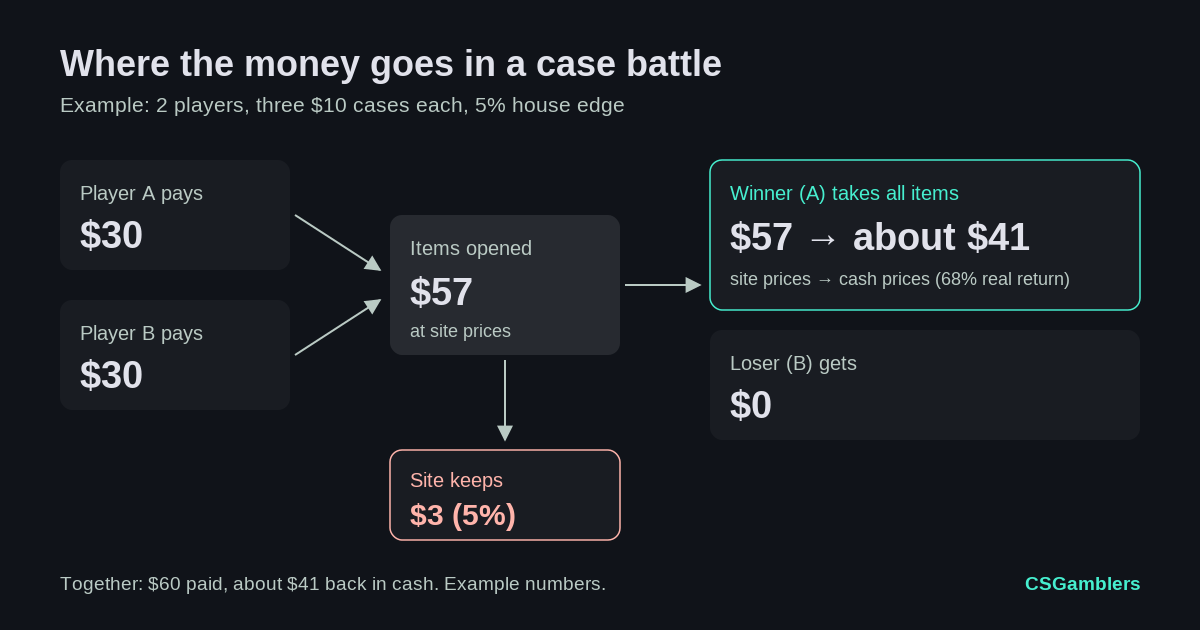
- Player A paid $30 and holds $57 in items: +$27 at site prices.
- Player B paid $30 and holds nothing: −$30.
- Together they paid $60 and hold $57: the site kept $3, exactly 5%.
The same battle at cash prices
Those $57 are priced like the Steam Market. On marketplaces that pay real money, the same skins sell for about 24–29% less. On CaseBattles, where we priced all 169 cases, the return fell from 94.4% at site prices to about 68% at cash prices.
Apply that to the example. The $57 pot is worth about $41 if A sells the skins for cash. A’s real gain is about $11, not $27. And the two players together got back about $41 of the $60 they paid.
What happens when the winner keeps battling
Most winners do not cash out. They join the next battle with their winnings, and the edge is taken again. At a 5% edge, ten rounds of re-entering cost about 40% of the starting balance on average. At 10%, about 65%. Battles are fast, so ten rounds can pass in a few minutes.
How to pick a case battle site
The best case battle sites for you are the ones that lose you the least per battle and let you take the pot out. Check these points:
- Published battle edge. A stated number beats silence. Lower is better.
- Item prices against the cash market. Look up the top items of the cases you plan to battle. Prices far above cash offers mean a lower real return.
- Withdrawal rules. Some sites need a recent deposit before any withdrawal or check your ID only when you cash out. See how to withdraw skins.
- Bots and fairness. If the site fills seats with bots, the bot plays the same odds. Provably fair checks show a roll was not changed, not that the odds are good.
Our rankings compare these points for each site, and case odds explains how to count a case’s return.
Limits that help
Battles reward quick decisions, and that is how budgets disappear. Set the amount you are fine losing before you start. Cash out a big pot instead of rolling it into a bigger battle. If you play to win money back, stop. Responsible gambling lists free help lines.
FAQ
Are case battles rigged?
A battle uses the same odds as the cases inside it. Sites that call battles provably fair let you check that each roll was not changed after the fact. That does not make the odds good: the house edge still applies to every case.
Do case battles have better odds than opening cases alone?
No. On average each player gets back the same share as opening the same cases alone. The difference is variance: one player takes the whole pot and the rest get nothing.
What happens in a tie?
Each site has its own tie rule. Check the battle mode description on the site before you join.