CS2 case odds: what you really get from a case
There are two kinds of CS2 case odds, and they work in different ways. Cases you open in the game with a key follow fixed odds by rarity. Cases on third-party case sites follow odds the site sets for every single item. This guide covers both, and shows how to tell a fair case from an expensive one.
Official CS2 case odds by rarity
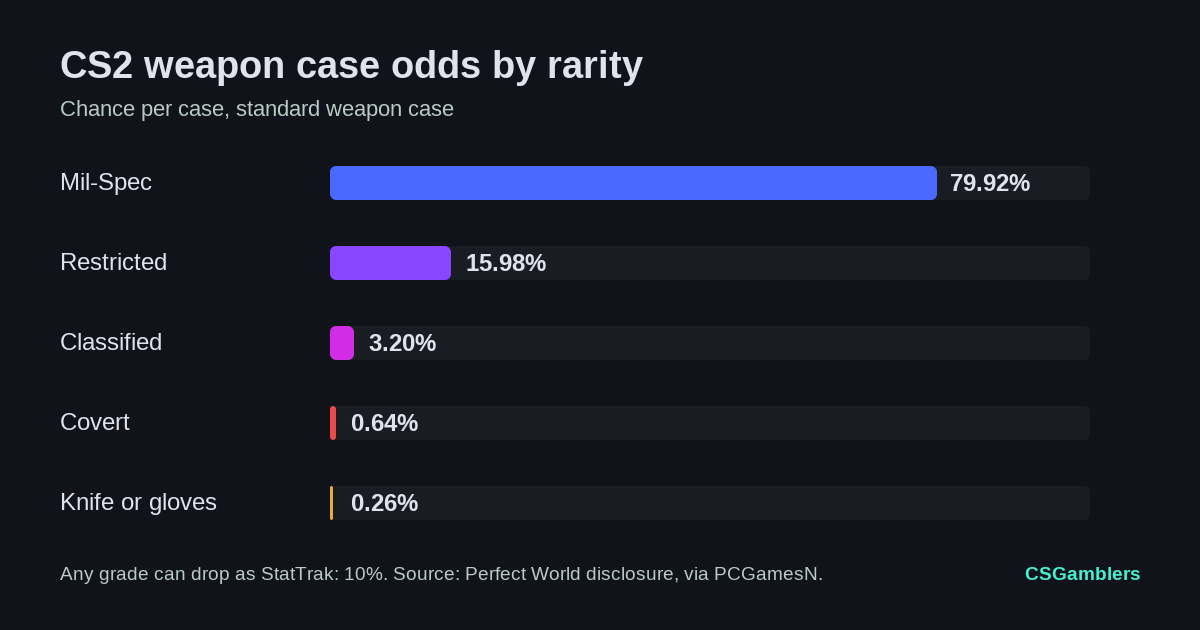
Valve has never put drop rates on a Steam page. The numbers players use come from Perfect World, Valve’s publishing partner in China, which had to disclose loot box odds when the game launched there. Perfect World gave the odds as ratios between rarity tiers, and the community converted them into percentages (PCGamesN).
| Rarity | Color | Chance per case |
|---|---|---|
| Mil-Spec | Blue | 79.92% |
| Restricted | Purple | 15.98% |
| Classified | Pink | 3.20% |
| Covert | Red | 0.64% |
| Rare special item (knife or gloves) | Gold | 0.26% |
Any item can also drop as StatTrak. Perfect World put that chance at 10% for every grade, so a StatTrak knife or glove comes out roughly once in 3,800 cases.
These odds are fixed per case. Opening more cases does not make the next one luckier. It only raises the chance that a rare drop shows up somewhere in a long run.
What the rarity odds mean in money
About four cases in five give you a Mil-Spec skin. Most Mil-Spec skins sell for far less than a key. The money in a case sits in the bottom 1% of outcomes, the Covert skins and the gold items. That is why the average return of an in-game case is low, even though one case in a few hundred pays for a lot of keys.
How case sites set their odds
Case sites do not use Valve’s cases. They build their own boxes from skins they price themselves, and they set a chance for each item. A $10 case on a site might list a $300 knife at 0.1% and a $2 pistol skin at 40%.
That changes how you should read the odds. On a site, rarity color tells you little. The only numbers that matter are the chance next to each item and the price the site puts on it.
Site return: chance times price
Multiply every item’s chance by its price and add them up. Divide by the case price. That is the case’s return at the site’s own prices.
Example: a $10 case holds three items. A $2 skin at 70% adds $1.40. A $12 skin at 25% adds $3.00. A $100 skin at 5% adds $5.00. The total is $9.40, so the case returns 94% and the house keeps 6%.
Case calculators do this sum for you. casecalculator.app is one of them. You can also do it by hand for a small case in a minute.
Why the site’s prices are the catch
Most case sites price items close to the Steam Market. Steam is the most expensive place to buy a skin, and Steam balance cannot be cashed out. On marketplaces that pay real money, the same skins sell for about 24–29% less.
We checked this on CaseBattles. Across all 169 of its cases, the median return at the site’s own prices was 94.4%. One example: an AK-47 Inheritance (Minimal Wear) was priced at $53.46 inside the cases, $50.63 on Steam, and the cheapest cash offer was $35.91. Recount the cases at cash prices and the return drops to about 68%. How we test explains the method.
House edge each site states
The house edge is the share the site keeps on average. Some sites publish it, most do not.
| Site | Cases | Battles | Source |
|---|---|---|---|
| CaseBattles | 5% | 5% | FAQ |
| CSGOEmpire | 8.8% | 8.8% | Help center |
| Clash.gg | Not readable | Not readable | FAQ page loads the table inside the app |
| Skin.Club | Not published | Not published | — |
| CSGORoll | Not published | Not published | — |
| Hellcase | Not published | Not published | Shows the drop chance per item in each case |
| Key-Drop | Not published | Not published | — |
A published edge is a good sign, but it is measured at the site’s prices. Keep the cash-price gap in mind on every site.
Best CS2 cases to open
There is no single best case. The best case to open is the one with the highest return per dollar, and that comes from the price-to-odds ratio, not from the top prize.
Three checks help:
- Count the return. Use the sum above or a case calculator. A case that returns 96% at site prices loses you less on average than one at 90%.
- Look at how much of the value hides in one item. If 60% of the return comes from a knife at 0.05%, most openings pay back a small fraction. A flatter case gives steadier results at the same return.
- Price the big items yourself. Look up the top three items on a cash marketplace. If the site prices them far above that, the case is worse than its listed odds suggest.
On CaseBattles, cheaper cases returned a little less (93.8% median) than the site average. That pattern is common: low-priced cases tend to lean on a few expensive long shots.
Re-opening with winnings
The edge is taken every time you open a case. If you keep re-opening with what you won, the losses stack. At a 5% edge, ten rounds of re-spinning cost you about 40% of the starting balance on average. At 10%, about 65%. Taking skins out early keeps more of your money than chasing one more case.
Provably fair is not the same as good odds
Many sites call their cases provably fair. That means you can check that a roll was not changed after you opened the case. It does not tell you whether the odds or the prices are good. A provably fair case with a 15% edge is still a 15% edge.
FAQ
What are the odds of getting a knife in CS2?
In a standard weapon case, a rare special item (knife or gloves) drops 0.26% of the time, about once in 385 cases, per Perfect World’s disclosure. On case sites, each case lists its own chance for every knife.
Are case site odds the same as Valve’s?
No. Case sites build their own cases and set a chance for every item. Read the item list and its percentages instead of the rarity colors.
How do I find the best CS2 case to open?
Work out the return: add up chance times price for every item and divide by the case price. Then check the expensive items on a cash marketplace. The case with the highest return at cash prices costs you the least on average.